
8 Things to Consider When Adding a Deck to Your Yard

A backyard deck is a wonderful way to connect indoors and outdoors, making better use of your home and property. They are there for you on those quiet mornings when you want to enjoy your coffee while listening to the birds sing, and they’re there for you when you have 50 of your closest friends over for an epic 4th of July BBQ. But custom decks in Breckenridge, CO, don’t build themselves, and there are several things to keep in mind before you start ordering lumber. In this guide, the team at Colorado Deck Works presents 8 things to consider when adding a deck to your yard.
Table of Contents
1: Will You Build It Yourself or Hire a Contractor?
There is an argument for building the deck yourself, and equally valid arguments for hiring a contractor. Let’s look at them now.
Why You Should Build the Deck Yourself
- By building the deck yourself, you could save money.
- You will have total control over the project from beginning to end.
- Once you’ve finished, you’ll have a great sense of accomplishment.
Why You Shouldn’t Build the Deck Yourself
- Depending on your experience level, your DIY deck may actually end up costing you more if you have to keep going back and correcting mistakes, or you have to hire a pro to correct something that went wrong.
- You will probably need to buy tools and equipment, which will also bump up the cost.
- It’s likely to take you a lot longer to complete the deck yourself than if you have a pro do it.

Why You Should Hire a Professional Deck Company
- You can sit back and relax, confident that the job will be done right.
- The whole project is going to go faster and with fewer hassles.
- The deck builder can likely handle permits and other technical aspects of the job for you.
The Downside of Hiring a Professional
- It might cost you more.
- You may have to vet several contractors before you find the right one.
- Once you agree to a design, you relinquish most of your control.
Whether you choose to do it yourself or hire a professional is up to you, but you will still need to make a couple of other considerations. Let’s look at the other considerations.
2: Purpose

Everyone has a mental image of how they’re going to use the deck once it’s finished. What’s yours? Do you envision large crowds for holiday BBQs? Or are you drawn to the possibility of the deck being a refuge where you can enjoy a good book while the sun sets? If you hope to create a party town in your backyard, you’ll need one kind of deck. If your only goal is to create a haven where you can commune with nature, you’ll want another kind of deck.
3: Design
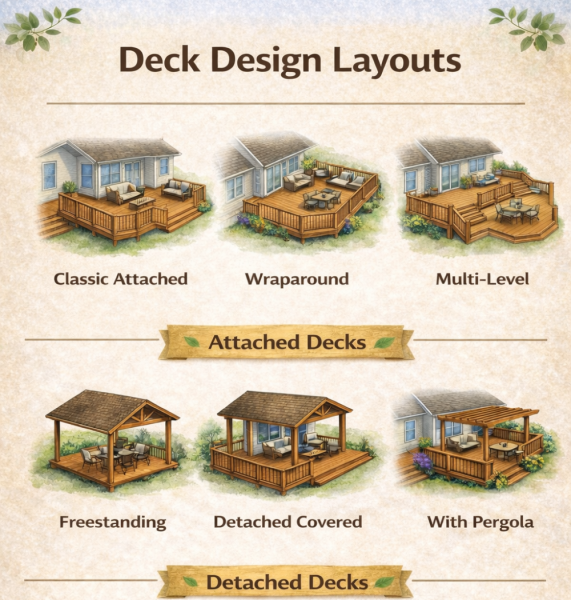
This will be determined to some degree by the purpose of your deck, but also by the specifics of your property. You actually have quite a few choices regarding the design of your deck. It can be on stilts and attached to the house, or a free-standing feature separate from the house. If it’s an elevated deck, you may be able to incorporate multiple levels. Or you may want to reserve space under the deck for storage of garden tools, your lawn mower, and other items.
4: Budget
This could arguably rank higher on the list, since it will drive many of your decisions. If money is no object, then you can pretty much build whatever you want. However, if, like most people, you don’t have unlimited funds to sink into a deck, then you will need to decide how much you do have to spend. Once you have your budget in place, you can then use it to determine size, style, and other considerations.
| Budget Level | Typical Deck Size | Material Tier |
|---|---|---|
| Entry | Smaller footprint | Pressure-treated lumber |
| Mid-range | Standard family deck | Better treated lumber or basic composite |
| Premium | Large / multi-level | High-end composite & metal railings |
5: Materials
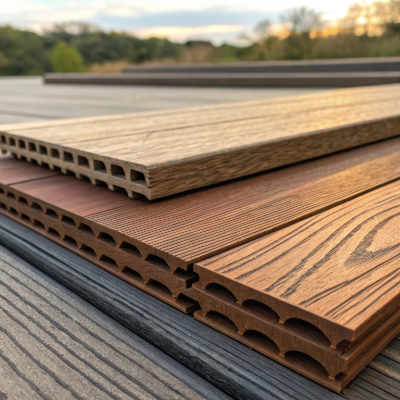
Compare material options—wood, composite, and metal—to match your budget and maintenance preferences.
Today, you have a wide variety of choices from pressure-treated lumber to aluminum, PVC, fiberglass, recycled wood, and various composites. Each one has its upside, and its downside – including cost, durability, and maintenance requirements – the pros at the decking company can explain them to you. If you are DIY-ing the deck, you will need to research the materials yourself.
6: Lighting
The advent of long-lasting, energy-efficient, easy-to-install LED lighting has revolutionized deck design. These days, just about any lighting scheme you have in mind can be easily realized, which means your deck doesn’t need to be vacated once the sun goes down. If there are stairs up to your deck, you can illuminate them to avoid accidents. You can also install accent lights to create any mood you want, and extend the lighting scheme into your yard’s paths, perhaps right to your pool.
Check out this video for some great deck lighting ideas:
7: Other Accessories
Besides lighting, you have a veritable cornucopia of accessories to choose from, each adding a distinctive element to your deck. Those accessories include deck railings, planters, built-in seating, deck gates, spiral staircases, a full or partial roof, a hot tub, and much more.
8: Privacy
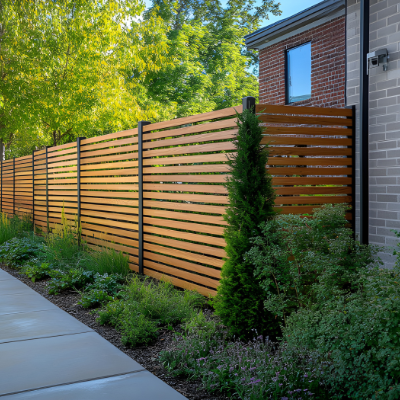
There’s a chance that sitting out on the deck will expose you to the neighbors’ prying eyes. If you’re okay with that, it’s not an issue. If, however, you would like to retain some level of privacy, you will need to keep that in mind when determining the design of the deck. The deck builder might be able to align the deck in a way that takes it out of the neighbor’s sightline, or you can install privacy screens that you can raise and lower as you wish.
Conclusion
A deck can be an invaluable addition to your home, but it’s important to remember that maintenance will be required. If you can factor that in and handle it in a timely and effective manner, your deck should bring you many years of happiness and satisfaction while also increasing the market value of your home. We hope you found this guide helpful. Remember, for all things decking in Breckenridge, CO, the company to call is Colorado Deck Works.